

Gallery
Description
Property Name: Karatay Madrasa
Inventory No: 90-332-4
Date of infill of the inventory form: 2009-10-27
Country (State party): Turkey
Province: Konya
Town:
Geographic coordinates: 37° 52′ 29.86″ N
32° 29′ 34.47″ E
Historic Period: 12th century, 2nd half
Year of Construction: 1251-2
Style: Seljuk
Original Use: Madrasa
Current Use: Museum
Architect: Unknown
Significance
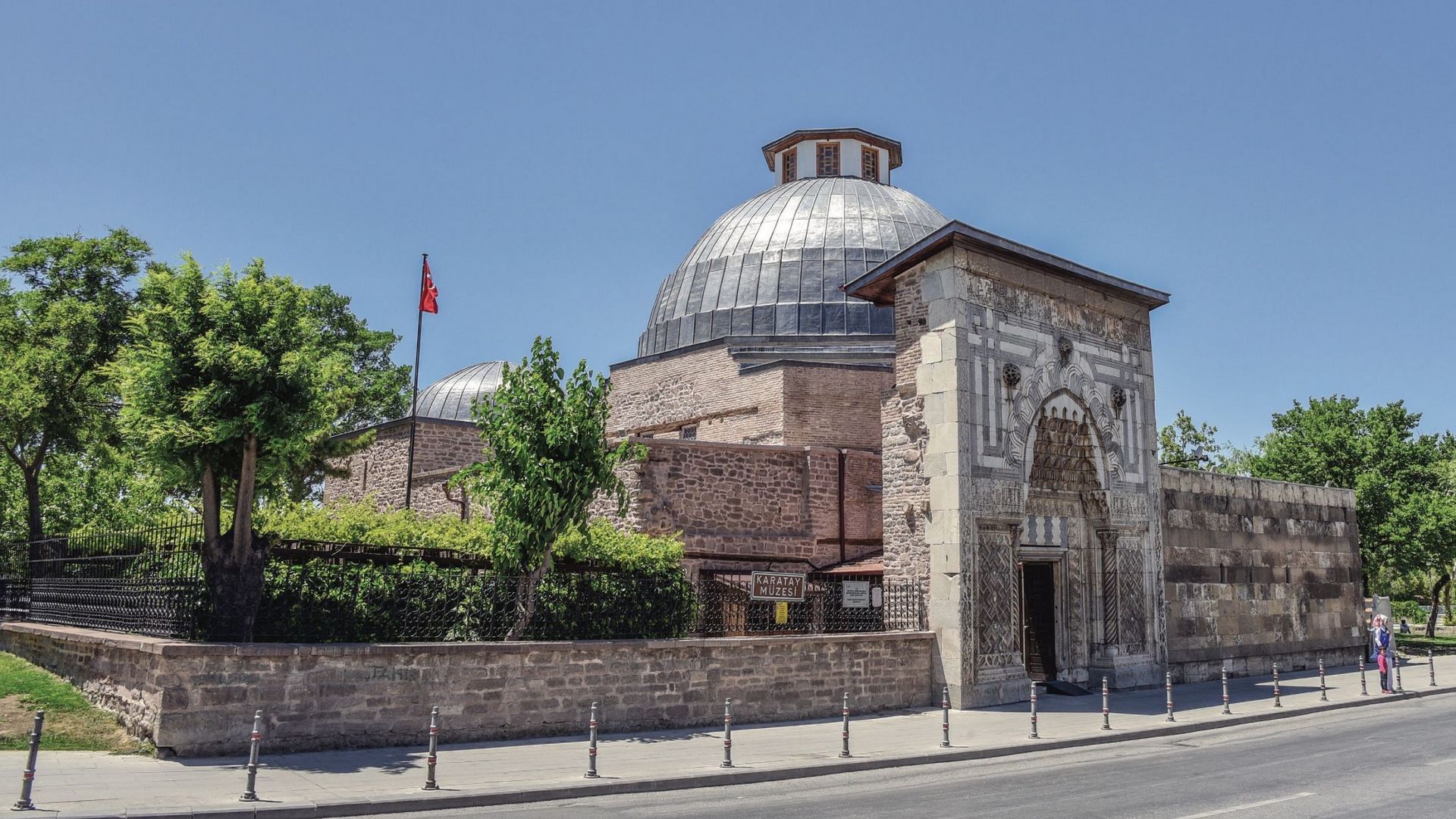
The mosque is one of the three madrasas that was founded in Konya, during Anatolia Seljuk Period, when Konya was the capital city. Therefore education was something important for this capital city. This madrasa, built by Emir Celaleddin Karatay during Sultan İzzeddin Keykuvas, is a product that reflects Anatolia Seljuk’s art and architecture taste; especially with its portal which is considered to be a masterpiece of sille stonework. And, the madrasa, with its closed ewan plan style, has the Arabic influence. Additionally, the beautiful truncated muqarnas niche is a prototype of muqarnas decorations used in classical Ottoman architecture. Today, the madrasa is used as an encaustic tile works museum, which makes the building an attraction point for visitors.
Selection Criteria
i. to represent a masterpiece of human creative genius
iii. to bear a unique or at least exceptional testimony to a cultural tradition or to a civilization which is living or which has disappeared
vi. to be directly or tangibly associated with events or living traditions, with ideas, or with beliefs, with artistic and literary works of outstanding universal significance
State of Preservation
The mid 13th century Madrasa has been left abandoned by the 19th century. The courtyard, just behind the entrance portal, within the madrasa site was covered with a dome; however presently it is an open air space. The madrasa building, once famous with its mosaic tiles has lost majority of tiles by the times; especially during the time when it was abandoned. In 1955, the madrasa was given a new function that is Karatay Encaustic Tile (ceramic tiles in which the pattern or figure on the surface is not a product of the glaze but of different colors of clay) Works Museum. The ruined students’ cells on the north and south are known to be rebuilt in the 1970s. Actually, the madrasa was not very well conserved, as it lost many of its fragments between late 19th century and 1955.
References
Stierlin, Henri. Architektur des Islam, Atlantis, Switzerland, 1979
Stierlin, Henri. Turkey From the Selçuks to the Ottomans, Taschen, Köln, 2002
Talbot, Tamara. The Seljuks, Thames and Hudson, London, 1961,
Türk Arkeoloji Dergisi, vol. XVIII, 2. Türk Tarih Kurumu Basımevi, Ankara, 1972,
Website of Republic of Turkey Ministry of Culture and Tourism; http://www.kultur.gov.tr ,
Website of Archnet; http://www.archnet.org,
Website of Islamic Architecture; http://www.islamic-architecture.info,
Website of Discover Islamic Art; http://www.discoverislamicart.org