

Gallery
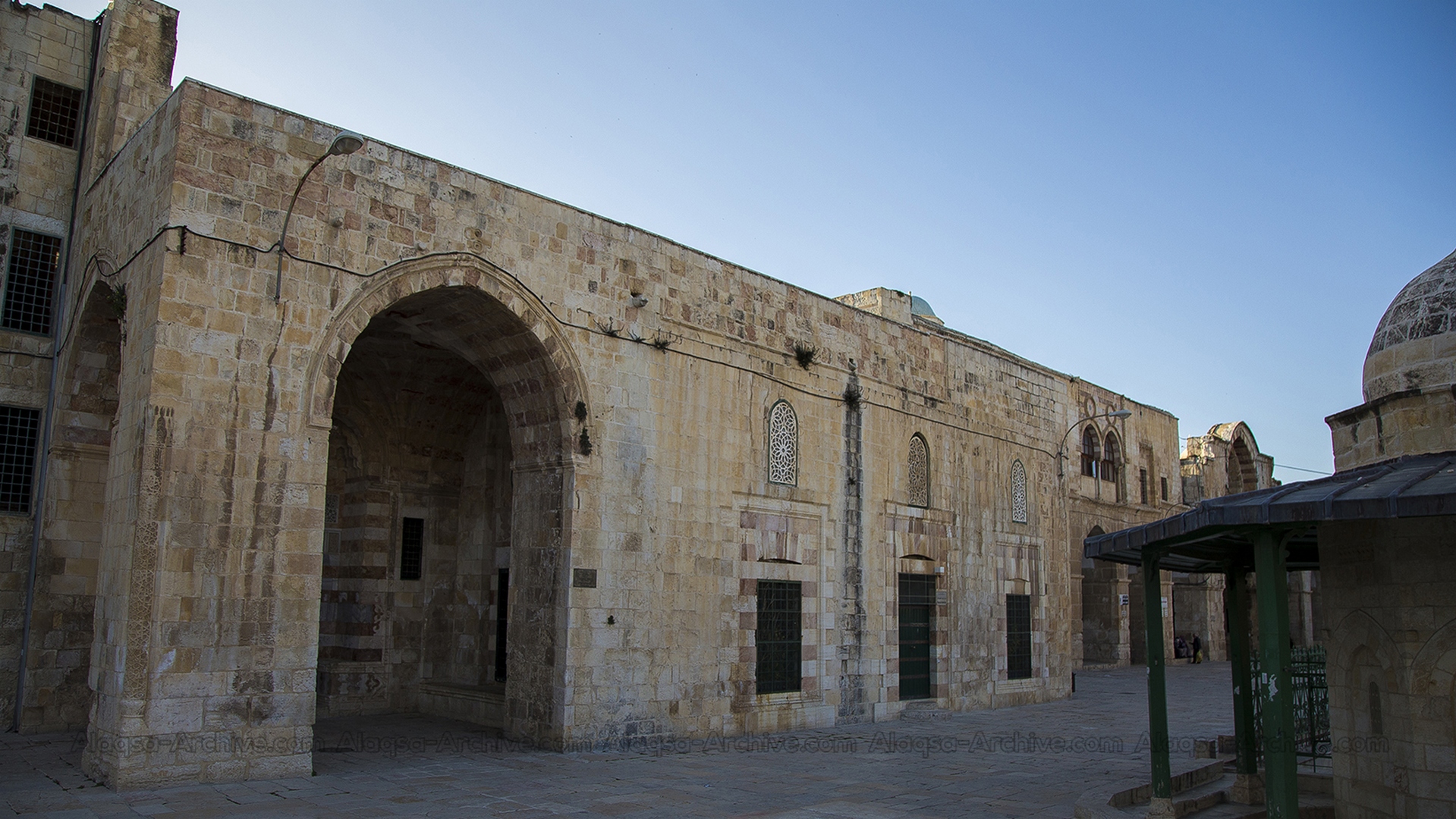
Description
Property Name: Al-Ashrafiyah School (in Al-Masjid Al-Aqsa)
Inventory No: 972-2-9
Date of infill of the inventory form: 2020-07-17
Country (State party): Palestine
Province: Al Quds/Jerusalem
Town: Old town
Geographic coordinates: 31°46’38.73″N
35°14’3.97″E
Historic Period: Mamluk
Year of Construction: 1426 AC
Style: Early Islamic
Original Use: School
Current Use: School
Architect: Unknown
Significance
Prince Hassan bin Tatr Ath-Thahiry built this school as a gift for King Ath-Thaher Khashqoum in 872 AH/1426 AC. However, the latter died before the construction was completed; thus, Prince Ath- Thahiry decided to dedicate it to Sultan Al-Ashraf Qaitbay who assigned scholars and teachers to it. When Sultan Qaitbay came to Jerusalem he visited the school, but was not quite impressed by the building, so he demolished it and ordered its reconstruction in 885 AH/1470 AC. Al-Ashrafiyah School is considered to be the third architectural jewel of Al-Aqsa Mosque besides Al-Qibly Mosque and the Dome of the Rock. Half of the school is located inside Al-Aqsa, while the other half is outside the Mosque’s borders. The school consists of a two-storey building, and has a beautiful entrance decorated with white and red bricks. It also has a mosque that was once used by the followers of the Hanbali principle. There are two graves inside its mosque; one of them is thought to be Sheikh Al-Khalil’si tomb.
Selection Criteria
ii. to exhibit an important interchange of human values, over a span of time or within a cultural area of the world, on developments in architecture or technology, monumental arts, town-planning or landscape design
iii. to bear a unique or at least exceptional testimony to a cultural tradition or to a civilization which is living or which has disappeared
vi. to be directly or tangibly associated with events or living traditions, with ideas, or with beliefs, with artistic and literary works of outstanding universal significance
State of Preservation
Today, a significant part of the school is used as Al-Aqsa Shar’ia School for Girls; another part is used as an office for the Department of Manuscripts subordinate to the Islamic Waqf Directorate, while the remaining parts are used as houses where some Jerusalemite families live. In 2000, the Islamic Waqf Department and the Welfare Association carried out a comprehensive renovation of the building.
References
ed. Auld, Sylvia and Hillenbrand, Robert; arch. survey by Yusuf Natsheh. Ottoman Jerusalem: the living city: 1517-1917. London: Altajir World of Islam Trust, 2000.
Al-Quds, A Historical Document. Organization of the Islamic Conference.
Bahat, Dan. A selection of Ottoman Structures in the old city of Jerusalem. Jerusalem: The Open University of Israel, 1990.
Bahat, Dan. Carta’s Historical Atlas of Jerusalem, 1983
Burgoyne, Michael Hamilton. Mamluk Jerusalem, an architectural study. Scorpion Publishing Ltd., Essex, England 1987
Creswell, K.A.C. A Short Account of Early Muslim Architecture. Penguin Books, Harmondswoth, 1958.
Duncan, Alistair, The Noble sanctuary: portrait of a holy place in Arab Jerusalem. London: Longman, 1972.
Elad, Amikam. Medieval Jerusalem and Islamic Holy Places, Ceremonies, Pilgrimage. |Brill Leiden, Netherlands, 1995.
Grabar, Oleg. Jerusalem, Constructing the Study of Islamic Art, Volume IV. Ashgate Publishing Company, Hampshire, 2005.
Grabar, Oleg. The Dome of the Rock. Thames and Hudson Ltd., London, 1996.
Ed. Hattstein, Markus, Delius. Peter. Islam Art and Architecture. Könemann Verlagsgesellshaft mbH, France, 2000.
Jerusalem Institute for Israel Studies, Statistical Yearbook of Jerusalem, 2002/03
Kroyanker, David. Jerusalem Architecture. Tauris Parke Books, London, 1994.
Najm, Raip Yusuf, The Treasures of Jerusalem. Arabic Cities Organization, Al-Beti Establishment, 1983.
Sha’th, Shawqi. Al-Quds Al-Shareef. ISESCO, Rabat,1995.
Wilson, Colonel Sir Charles W. Jerusalem, The Holy City. Ariel Publishing House, Jerusalem.
Flood, F.B. 1997. Umayyad Survivals and Mamluk Revivals: Qalawunid Architecture and the Great Mosque of Damascus. Muqarnas XIV: An Annual on the Visual Culture of the Islamic World. Gülru Necipoglu (ed). Leiden: E.J. Brill, 57-79.
Grabar, Oleg. The Haram al-Sharid: An Essay in Interpretation, BRIIFS vol.2 no.2 Autumn 2000.
Jarrar, Sabri. 1998. Suq al-Ma’rifa: An Ayyubid Hanbalite Shrine in al-Haram al-Sharif. Muqarnas XV: An Annual on the Visual Culture of the Islamic World. Gülru Necipoglu (ed.) Leiden: E.J. Brill, 71-100.
Khalidi, Walid. The Dome of the Rock. Retrieved from Saudi Aramco World website: http://www.saudiaramcoworld.com/issue/199605/the.dome.of.the.rock.htm
Khoury, Nuha N.N. 1993. The Dome of the Rock, the Ka’ba, and Ghumdan: Arab Myths and Umayyad Monuments. Muqarnas X: An Annual on Islamic Art and Architecture. Margaret B. Sevcenko (ed.). Leiden: E.J. Brill.
Laurent, B. and Riedlmayer, A. Restorations of Jerusalem and The Dome of The Rock and Their Political Significance, 1537-1928
Leisten, Thomas. 1996. Mashhad Al-Nasr: Monuments of War and Victory in Medieval Islamic Art. Muqarnas Volume XIII: An Annual on the Visual Culture of the Islamic World. Gülru Necipoglu (ed.). Leiden: E.J. Brill.
Rabbat, Nasser. 1989. The Meaning of the Umayyad Dome of the Rock. Muqarnas VI: An Annual on Islamic Art and Architecture. Oleg Grabar (ed.). Leiden: E.J. Brill.
Rabbat, Nasser. 1993. The Dome of the Rock Revisited: Some Remarks on al-Wasiti’s Accounts. Muqarnas X: An Annual on Islamic Art and Architecture. Margaret B. Sevcenko (ed.). Leiden: E.J. Brill.
Richard Ettinghausen, Oleg Grabar, Marilyn Jenkins-Madina (1987),The Art and Architecture of Islam 650-1250 c.e. (pp.28-34)
Yavuz, Yildirim. 1996. The Restoration Project of the Masjid al-Aqsa by Mimar Kemalettin (1922-26). Muqarnas Volume XIII: An Annual on the Visual Culture of the Islamic World. Gülru Necipoglu (ed.). Leiden: E.J. Brill.
UNESCO, (1995) General Conference Twenty-eighth Session Report
Archnet website: archnet.org