

Gallery
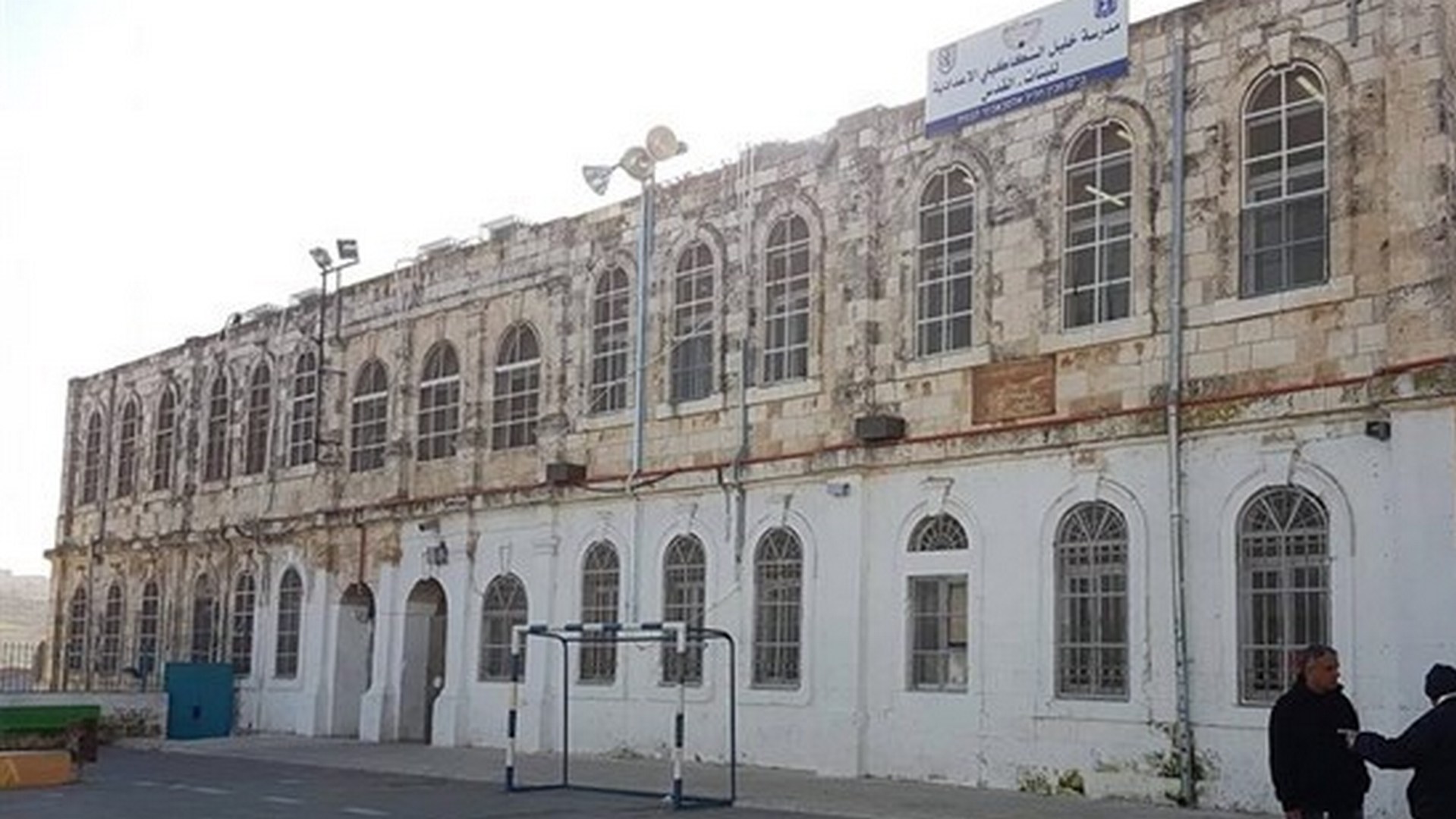
Description
Property Name: Khalil al-Sakakini School
Inventory No: 972-2-20
Date of infill of the inventory form: 2020-08-04
Country (State party): Palestine
Province: Al Quds/Jerusalem
Town: Al Quds
Geographic coordinates: 31°47’35.28″N
35°13’47.66″E
Historic Period: Ayyubid
Year of Construction: 1147 AC
Style:
Original Use: School
Current Use: School
Architect: Unknown
Significance
In the Ayyubid period, Salah al-Din al-Ayyubi transformed the place into private waqf for the Royal Palace, and the basic construction was rebuilt in 1193 during the reign of Aziz Othman, and responsibility for the construction took place Maymoon Abdullah al-Qusri, the Minister of the Treasury of Salah al-Din, and the building later turned into a school that taught Shafi’i school.
Selection Criteria
ii. to exhibit an important interchange of human values, over a span of time or within a cultural area of the world, on developments in architecture or technology, monumental arts, town-planning or landscape design
iii. to bear a unique or at least exceptional testimony to a cultural tradition or to a civilization which is living or which has disappeared
vi. to be directly or tangibly associated with events or living traditions, with ideas, or with beliefs, with artistic and literary works of outstanding universal significance
State of Preservation
The upper floor was destroyed in the Mamluk period as a result of an earthquake and was rebuilt. Then, it was restored in the early Ottoman period and used as ،Kuttabs, but it was neglected in the end and no waqf was stopped until it became empty.
With the advent of the British Mandate, transferred to the property of the British state, and from there to the property of the Jordanian state, education revived in the building again, and the school bore the name “Khalil Sakakini”, since the occupation of Jerusalem in 1967, the building was automatically converted into state property, and the name of the school changed to Qadisiyah, and then returned to the name Khalil Sakakini. A decision was issued by the occupation to close the school and turn it into a museum, or it would be for the Israel Antiquities Authority.
References
Leisten, Thomas. 1996. Mashhad Al-Nasr: Monuments of War and Victory in Medieval Islamic Art. Muqarnas Volume XIII: An Annual on the Visual Culture of the Islamic World. Gülru Necipoglu (ed.). Leiden: E.J. Brill.
Rabbat, Nasser. 1989. The Meaning of the Umayyad Dome of the Rock. Muqarnas VI: An Annual on Islamic Art and Architecture. Oleg Grabar (ed.). Leiden: E.J. Brill.
Rabbat, Nasser. 1993. The Dome of the Rock Revisited: Some Remarks on al-Wasiti’s Accounts. Muqarnas X: An Annual on Islamic Art and Architecture. Margaret B. Sevcenko (ed.). Leiden: E.J. Brill.
Richard Ettinghausen, Oleg Grabar, Marilyn Jenkins-Madina (1987),The Art and Architecture of Islam 650-1250 c.e. (pp.28-34)
Yavuz, Yildirim. 1996. The Restoration Project of the Masjid al-Aqsa by Mimar Kemalettin (1922-26). Muqarnas Volume XIII: An Annual on the Visual Culture of the Islamic World. Gülru Necipoglu (ed.). Leiden: E.J. Brill.
UNESCO, (1995) General Conference Twenty-eighth Session Report
Archnet website: archnet.org
Organization of the Islamic Conference Research Centre for Islamic History, Art and Culture
AL-QUDS/JERUSALEM IN HISTORICAL PHOTOGRAPHS: İSTANBUL, 2 0 0 9.