

Gallery
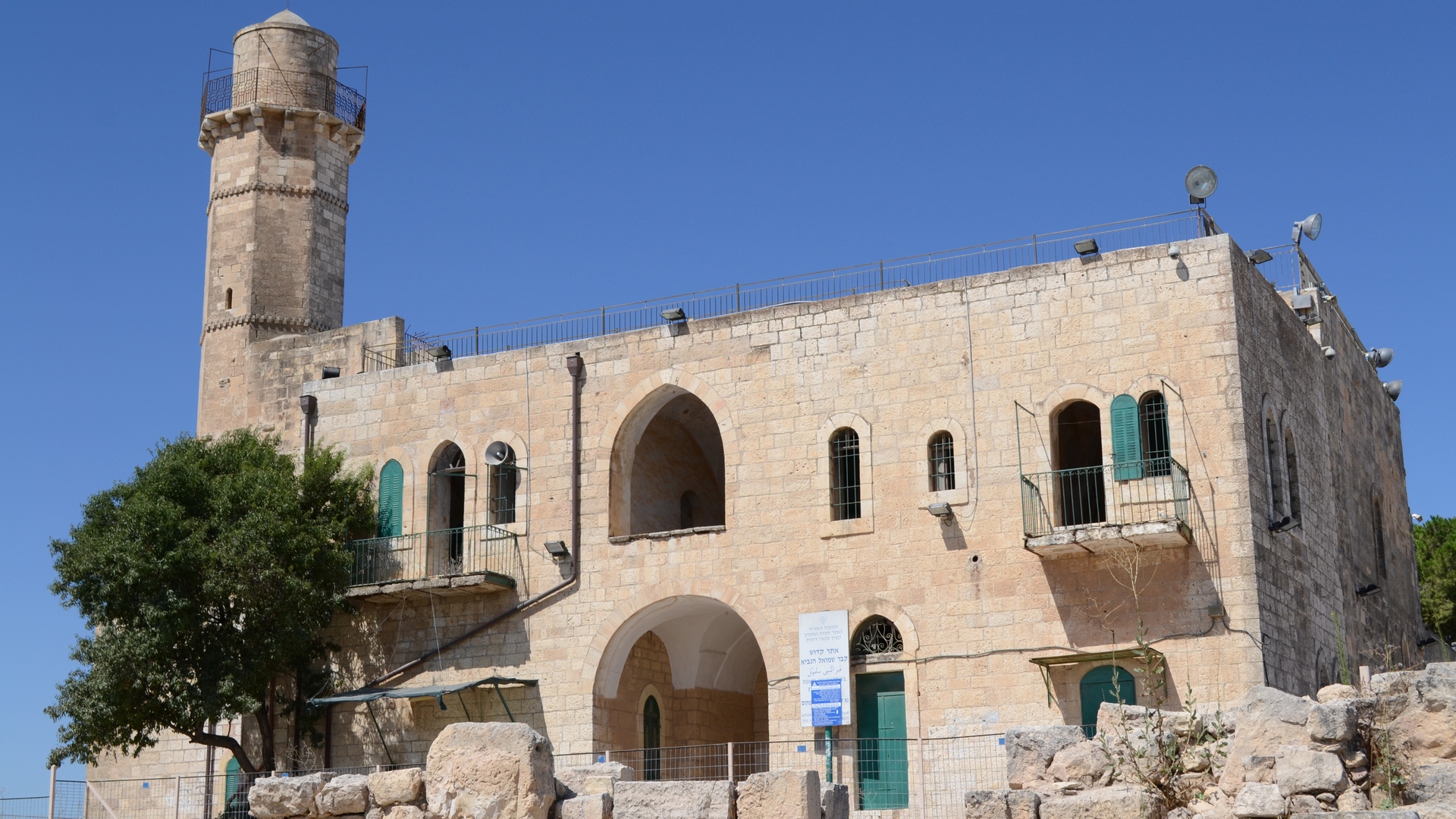
Description
Property Name: Mosque of the Prophet Samuel
Inventory No: 972-2-22
Date of infill of the inventory form: 2020-08-10
Country (State party): Palestine
Province: Al Quds/Jerusalem
Town: Al Quds
Geographic coordinates: 31°49’58.42″N
35°10’51.91″E
Historic Period: Ottoman
Year of Construction: 1720
Style: Ottoman
Original Use: Mosque
Current Use: Worship
Architect: Unknown
Significance
The Prophet Samuel Mosque is one of the ancient Ottoman mosques. It is an Islamic endowment that includes a large area of agricultural land on a strategic site that completely exposes Jerusalem and the Palestinian coast. It consists of several floors and has a high minaret. The Mosque between Jerusalem and Ramallah; in 1900, the Israeli occupation forces demolished the village of Nabi Samwil and kept the mosque without demolishing, but the Jewish settlers took control of most of it.
Selection Criteria
ii. to exhibit an important interchange of human values, over a span of time or within a cultural area of the world, on developments in architecture or technology, monumental arts, town-planning or landscape design
iii. to bear a unique or at least exceptional testimony to a cultural tradition or to a civilization which is living or which has disappeared
vi. to be directly or tangibly associated with events or living traditions, with ideas, or with beliefs, with artistic and literary works of outstanding universal significance
State of Preservation
In 1993, a religious Jewish school was built near the mosque. In January 2015, the so-called Civil Administration closed the external gate leading to the mosque. The mosque has been subjected to a series of attacks since the nineties until now, including: burning and cracking, preventing the raising of the call to prayer, taking off the loudspeakers, striking worshipers by settlers, and surrounding the mosque with barbed wire and surveillance cameras, in addition to closing the second floor of it and preventing the restoration of the third floor and keeping it deserted. The basement has been converted into a synagogue.
References
Yusuf, Faraj Allah Ahmad. 2011. Mosques of Palestine: under the Zionist occupation. Dar Al-Qalam, 2011.
Leisten, Thomas. 1996. Mashhad Al-Nasr: Monuments of War and Victory in Medieval Islamic Art. Muqarnas Volume XIII: An Annual on the Visual Culture of the Islamic World. Gülru Necipoglu (ed.). Leiden: E.J. Brill.
Rabbat, Nasser. 1989. The Meaning of the Umayyad Dome of the Rock. Muqarnas VI: An Annual on Islamic Art and Architecture. Oleg Grabar (ed.). Leiden: E.J. Brill.
Rabbat, Nasser. 1993. The Dome of the Rock Revisited: Some Remarks on al-Wasiti’s Accounts. Muqarnas X: An Annual on Islamic Art and Architecture. Margaret B. Sevcenko (ed.). Leiden: E.J. Brill.
Richard Ettinghausen, Oleg Grabar, Marilyn Jenkins-Madina (1987),The Art and Architecture of Islam 650-1250 c.e. (pp.28-34)
Yavuz, Yildirim. 1996. The Restoration Project of the Masjid al-Aqsa by Mimar Kemalettin (1922-26). Muqarnas Volume XIII: An Annual on the Visual Culture of the Islamic World. Gülru Necipoglu (ed.). Leiden: E.J. Brill.
UNESCO, (1995) General Conference Twenty-eighth Session Report
Archnet website: archnet.org
Organization of the Islamic Conference Research Centre for Islamic History, Art and Culture
AL-QUDS/JERUSALEM IN HISTORICAL PHOTOGRAPHS: İSTANBUL, 2 0 0 9.